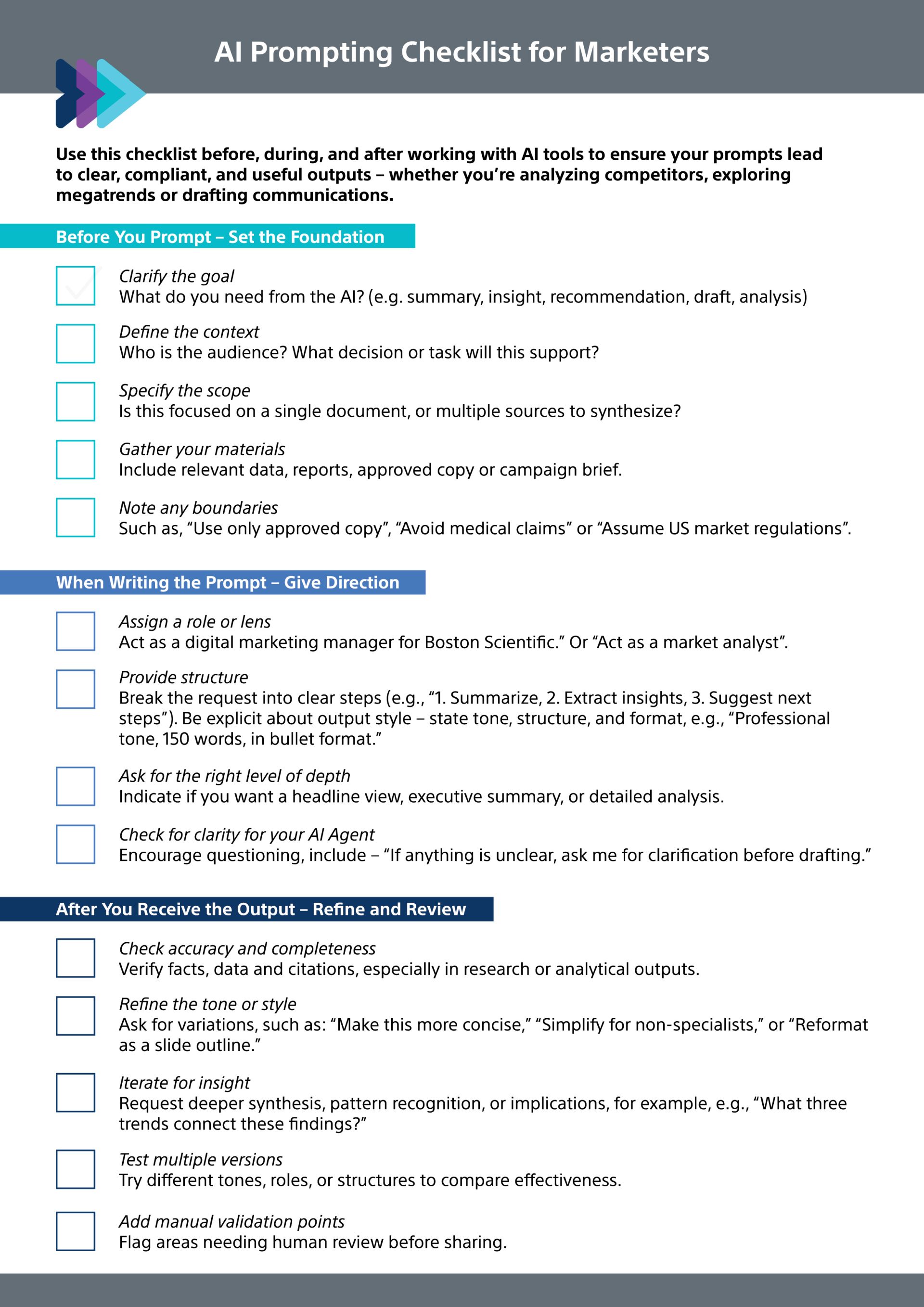
AI tools don’t read between the lines –
they take your words literally. The more precisely you describe what you want,
the more tailored and accurate the response will be. Vague prompts produce
generic outputs. Being specific about task, goal, audience, channel, tone, format,
length and context will help give stronger, more useable results. Clear
prompts save time and make results easier to use, whether you’re requesting a
content outline, summarizing research, or comparing competitors. For example:
“Tell me about competitor products that treat [disease].”
“Summarize competitor X, Y and Z’s key product launches in the [treatment area] from the past 12 months.”
“Compare competitor X and Y’s recent product launches (past 12 months in the [treatment area]). Include: product name, category, target audience, feature and benefit comparison and key message. Present in a 9-column table (Competitor, Product, Launch Date, Category. Target Audience, Features, Benefits, Key Messages and Summary). Highlight any emerging themes or gaps Boston Scientific could address.”
AI performs better when it understands the perspective it’s meant to take. Giving it a “role” – such as copywriter, market analyst, or category manager – helps shape its thinking and makes the outputs more relevant and actionable. This technique works for everything from internal summaries and content creation to brainstorming support and deep research. For example:
“Write LinkedIn copy for a launch of our Cath Lab workflow guide.”
“Act as a MedTech content marketer. Write a LinkedIn post announcing the availability of our Cath lab workflow guide for clinicians.”
“Act as a MedTech content strategist for Boston Scientific. Write a LinkedIn post for interventional cardiologists promoting our peer-reviewed workflow guide. Voice: credible, collegial, not salesy. Use only these approved descriptors: [paste]. Include 1 hook, 3 value bullets, and a compliant CTA to ‘Download guide.’ Add 3 hashtags that interventional cardiologists actually use.”
Complex marketing tasks often involve multiple stages, which could include – research, synthesize, summarize, analyze, create, format – and AI handles these best when you spell them out in sequence. Breaking your prompt into smaller, numbered steps prevents the AI from guessing what you want first. Structured requests lead to structured outputs that are easier to review, edit and use.
“Research competitor activity in [specify context].”
“Find three competitors and summarize their digital presence in [specify context].”
“1)
Identify three major competitors in the in [specify context e.g. SICD market].
2) Summarize their top messaging themes from recent press releases, web copy or
LinkedIn posts.
3) Extract three insights about their positioning or customer focus.
4) Present findings in a concise table with a final bullet summary of what
Boston Scientific could learn.”
AI needs guidance on how the content should sound and look – it can adapt its writing and output style if you tell it what you want. This applies to all output including narrative documents, strategic plans, competitor summaries and PowerPoint presentations not just marketing communications copy. Specify if you want the output to be conversational, formal, friendly, professional, playful, or informative to guide tone. If you need a specific structure – such as “three short paragraphs” or “two bullet points and a CTA / takeaway”, include that too. You can also ask for particular output formats – tables, bullet lists, executive summaries or slide-ready outlines – to save editing time later. For example:
“Summarize this meeting [attach meeting notes / verbatim recording].”
“Summarize this meeting in a few paragraphs.”
“Summarize these meeting notes for senior marketing leadership. Format as:
- Key actions (with owner and deadline)
Tone: professional, neutral, and concise. Limit to 200 words."
AI prompting is a process, not a one-shot task. Think of it as a conversation: you give direction, review the output and fine-tune it. Use iteration to clarify calculations, reformat insights, or adjust tone; small adjustments, such as “make this sound more casual”, “add three bullet points to summarize key benefits” or “explain this in simpler language”, can dramatically improve the end result. Iteration isn’t a sign of failure; each time you refine your prompt, the AI learns more about what you want, and your results will improve.
“Make this research clearer.”
“Rewrite this megatrends summary so it’s easier to understand and reduce it to 250 words.”
“Refine this megatrends research summary to:
- Add a concise executive overview (≤100 words) highlighting the most relevant trends for the healthcare sector.
- Identify three emerging shifts with potential impact on MedTech marketing or operations.
- Replace technical jargon with plain, professional language suitable for a senior audience.
- Conclude with a short bullet list of implications or next steps for Boston Scientific’s marketing strategy.
- Finally, include a version 2 comparison table showing the main edits or additions you made.”
Even skilled marketers can overlook details when prompting. The most common issues are being too brief, forgetting to define the audience or purpose, and failing to specify the desired output. These gaps leave the AI to guess your intent, often producing bland, vague or inconsistent results. Another frequent mistake is using AI output without proper review – especially important in regulated industries like ours. Always edit, fact-check, and validate the final work (keeping in mind that it must be acceptable to HEMA etc.) before sharing it externally. For example:
“Create audience segments for [product name] from this dataset.”
“Group our customers for [product name] from this dataset into segments based on firmographics and behavior.”
“Segment this customer dataset to identify three to five distinct audience groups for our marketing strategy for [product name].
- Use purchase behavior, role, and type of hospital as primary variables.
- Clearly label each segment with a short descriptor (e.g., ‘Value Seekers’, ‘Tech Adopters’).
- Provide a short summary of each group’s key needs and preferred communication style.
- Highlight any data limitations or assumptions made during segmentation.
- End with a checklist of what should be manually validated before using the results in campaigns.”
Prompting is a much art as science. There is no single formula that works every time because each AI model interprets language differently. The best way to improve is to test variations – try different wording, formats, or roles, and compare the results. Over time, you’ll develop an intuition for how to phrase prompts that fit your objectives. For example:
“Give me headline ideas for an internal newsletter on [specify topic].”
“Give me five headline options for an internal newsletter on [specify topic] that are engaging.”
“Generate three sets of headlines for an internal newsletter on [specify topic]:
- Version A: informative and factual
- Version B: engaging and conversational
- Version C: thought-leadership tone
Include a one-line note on when each tone would be most effective. Then suggest which version to test first, and why.”